 Coachigo
Progress and stats
How Coachigo calculates records and estimated 1RM
Epley formula, one record per exercise, bodyweight and timed exercises: how Coachigo calculates your clients' estimated 1RM and records, and where to find them.
Coachigo spots your clients’ records on its own, from the sets they log. To compare a heavy set with a longer one, it uses a common yardstick: the estimated 1RM, the weight your client could lift for a single rep.
Estimated 1RM: the Epley formula
Coachigo uses the Epley formula:
Estimated 1RM = weight × (1 + reps ÷ 30)
The result is rounded to one decimal place. A single-rep set simply gives the weight itself.
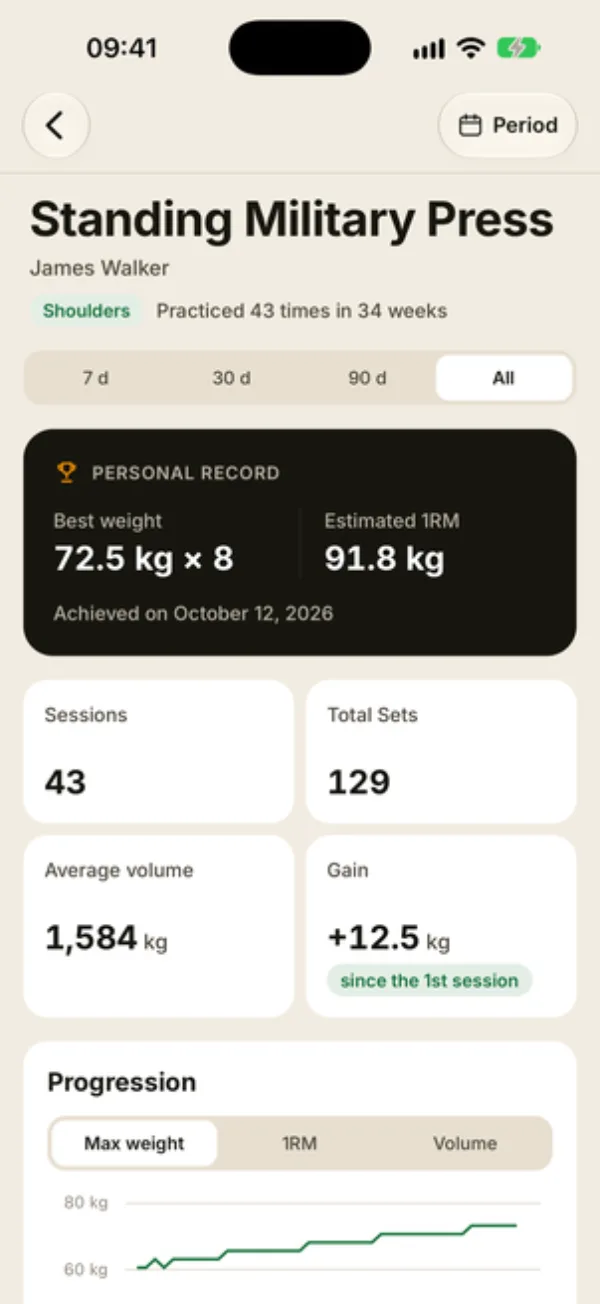
A real example: your client does 8 reps at 72.5 kg on the military press. 72.5 × (1 + 8 ÷ 30) = 72.5 × 1.267, for an estimated 1RM of 91.8 kg. In the same way, 8 reps at 112.5 kg give 142.5 kg.
An estimate, not a test
There’s no rep cap: 30 reps double the weight. Past a dozen reps or so, the estimate gets rough. It’s most useful for comparing a client with themselves, session to session.
What counts as a record
For each exercise, Coachigo keeps one record set:
- weighted exercise: the set with the best estimated 1RM, not necessarily the heaviest one. 100 kg × 8 (126.7 kg estimated) beats 110 kg × 3 (121 kg estimated);
- bodyweight exercise: the set with the most reps;
- timed exercise: the longest set.
The records lists (detailed statistics and exercise statistics) keep each exercise’s best set, even if it was only done once. On a tie, the date shown is from the most recent session.
The session summary is stricter: the set has to beat the best set from your client’s earlier sessions. An exercise done for the first time, or a simple tie, isn’t a record there.
Where to see records
- Session summary: the Key points block shows “Record:” followed by the exercise, bodyweight and timed ones included, and the set itself gets a Record tag. See reading a session summary.
- Client profile: Key points shows the most recent record on a weighted exercise, if it was set in the last 30 days. This block follows the lists’ rule, so an exercise done for the first time can show up there.
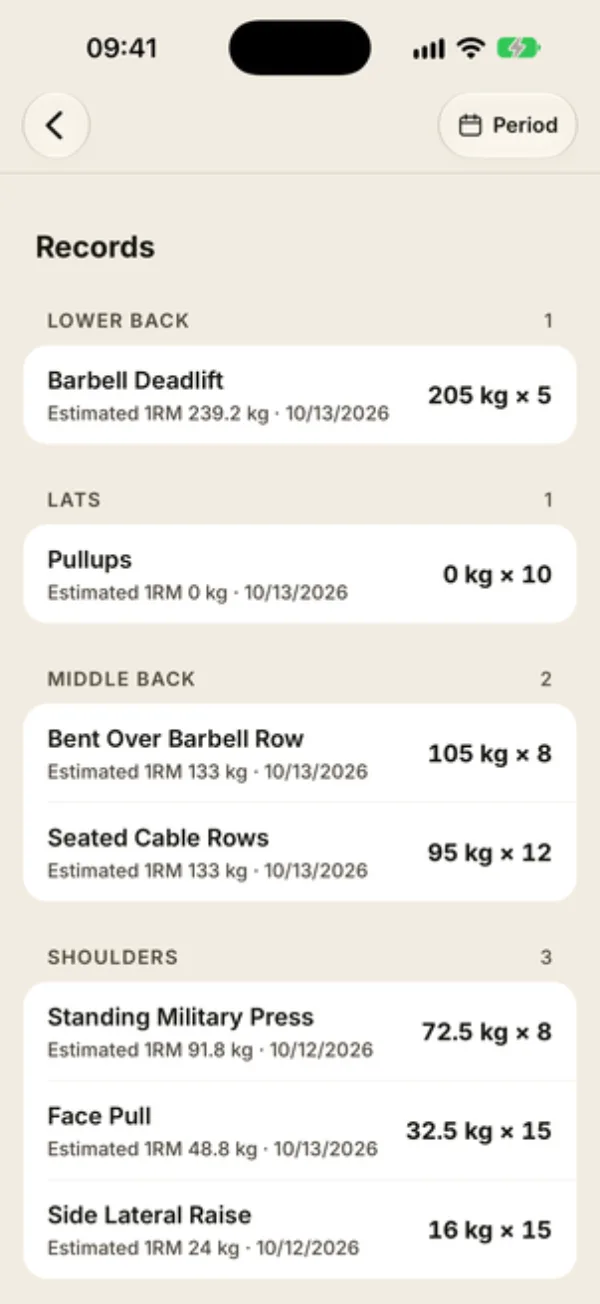
- Detailed statistics: the Records tile and, at the bottom, the list by muscle group, with “Estimated 1RM”, the date and the set on the right. See a client’s statistics.
- Exercise statistics: the PERSONAL RECORD card.
An exercise’s Personal Record card
In an exercise’s statistics, the PERSONAL RECORD card shows Best weight (weight × reps), Best reps for a bodyweight exercise or Best time for a timed one, then, for a weighted exercise, the Estimated 1RM, and finally the date (“Achieved on”).
That’s the best place to follow a bodyweight exercise: the records list in detailed statistics shows those exercises as “0 kg”, while the exercise’s own card shows the reps.
Records during a session
During a session, on a weighted exercise, a trophy flags a weight heavier than anything from your client’s earlier sessions. The session summary, on the other hand, judges records by estimated 1RM. So the two can differ: more reps at the same weight will be a record in the summary, with no trophy during the session.
FAQ
Why isn’t the heaviest set the record?
Because records are judged by estimated 1RM. A slightly lighter set with more reps can be the better effort.
Does estimated 1RM replace a real 1RM test?
No. It’s a benchmark for tracking progress without testing a true max. If your client does test one, log it as a single-rep set: the estimated 1RM will equal the weight.
Why hasn’t an exercise’s record changed in a while?
Your client has to beat the record set’s exact estimated 1RM. A tie doesn’t change the value: only the date moves to the most recent session. If nothing moves for several weeks, the exercise may show up in plateau alerts.